Temporary Facilities | SPACECOOL INC.

SOLUTIONS - Temporary Facilities

Unit houses, containers, etc.

Resources

Current thermal issues and solutions with SPACECOOL

Increase in heatstroke risk from rising indoor temperatures in summer

  • Helps lower WBGT and support MHLW-defined workplace heatstroke measures

Heat damage and quality degradation of stored items

  • Helps suppress indoor temperature rise and improve storage quality

Increase in electricity use and CO₂ emissions from AC operation

  • Helps reduce cooling load and lower AC costs and CO₂ emissions

Challenges of Conventional Heat Countermeasures

Thermal Insulation Material

  • Thick insulation reduces loading efficiency and increases weight
  • Stored heat raises temperatures at night

Air Conditioners

  • Consumes significant electricity for cooling and results in CO₂ emissions

Demonstration results: temperature reduction in tents

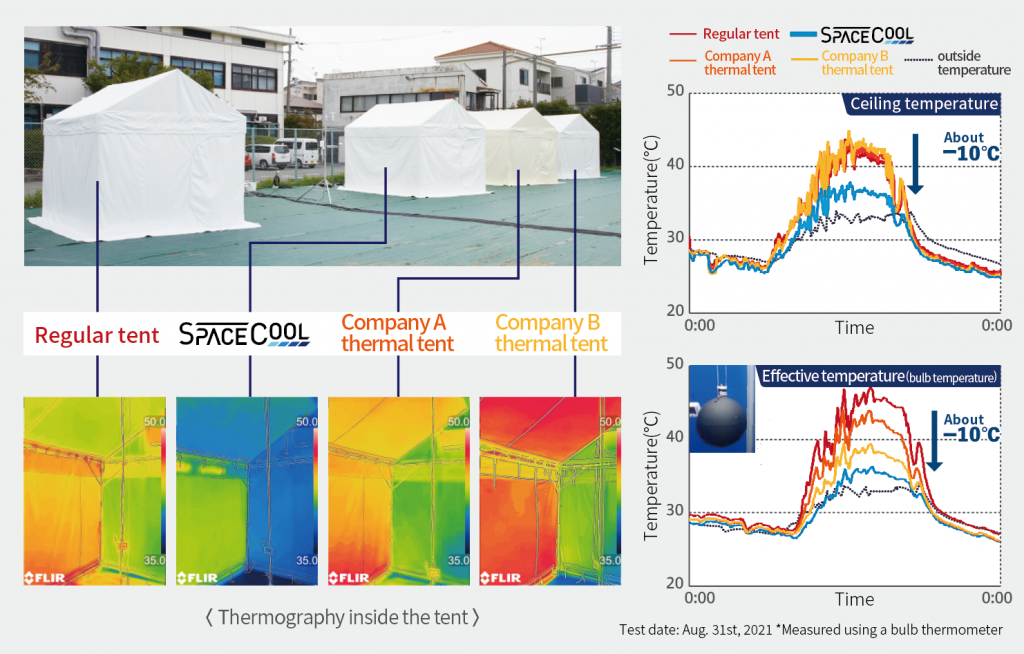
Comparison between SPACECOOL tents and tents using other materials, showing a reduction of approximately 10°C in perceived temperature.

Test conditions

Date
August 31, 2021
Comparison target
Comparison between a SPACECOOL tent, two heat-shielding tents from other companies, and a standard fabric tent

Test results

  • A temperature drop of approximately -10°C was recorded in both ceiling temperature and perceived temperature.

Case study and results: container houses in Saudi Arabia

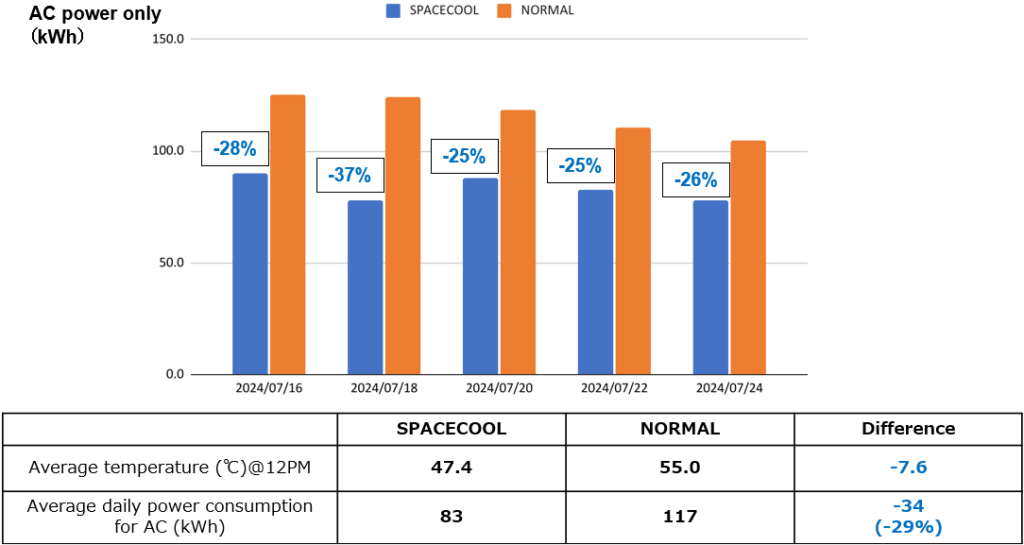
AC energy consumption was reduced by about 29% vs. non-installed units.
About 21 t of CO₂ reduction is estimated over 15 years.
Clients
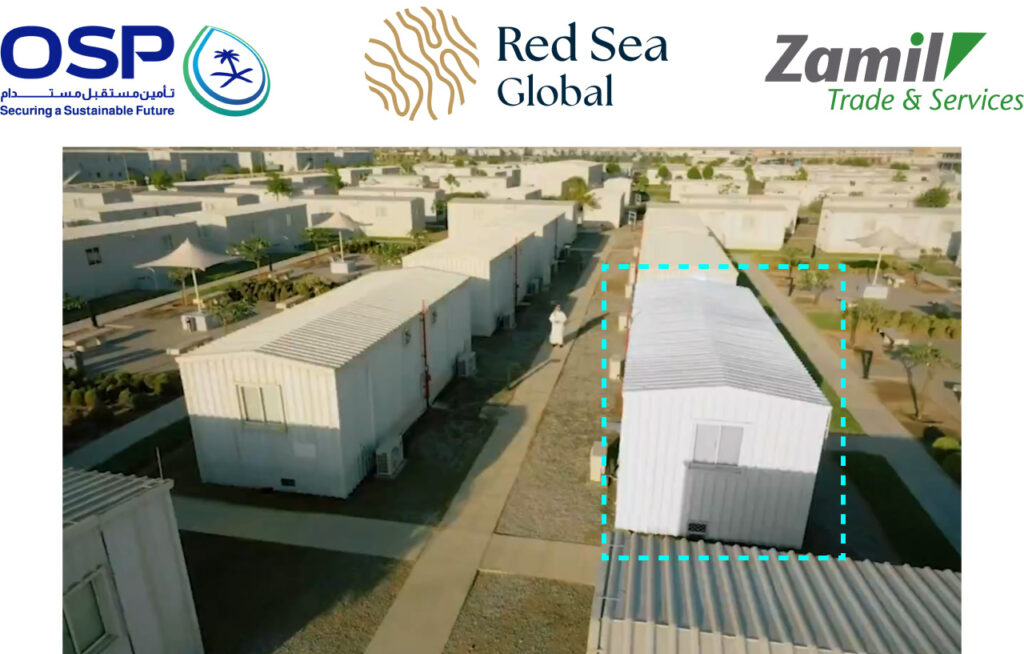
Red Sea Global; Zamil Group Trade and Services Company
Application
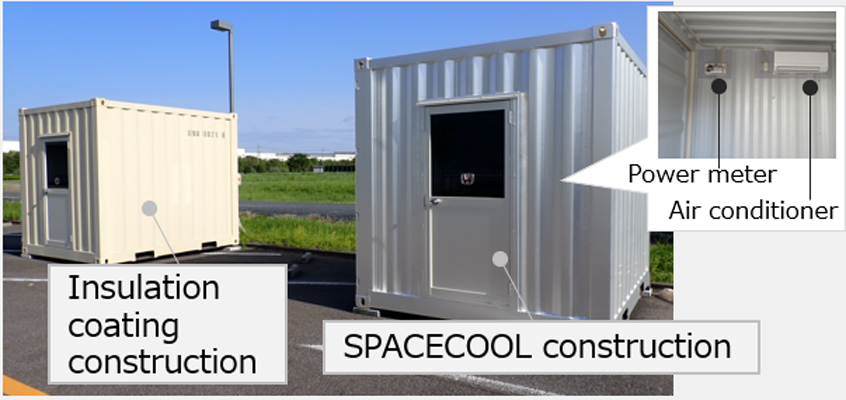
Container houses
Objective
To reduce air-conditioning energy consumption and CO₂ emissions from container houses

Test conditions

Location
Saudi Arabia
Installation Scope
Two container houses owned by Red Sea Global (12 m × 3.6 m × 3.7 m each)

Test results

Occupied units (7/16–7/24)
Average −29% / Maximum −37% in AC energy consumption
Unoccupied units (8/31–9/29)
Average −49% / Maximum −64% in AC energy consumption
CO₂ reduction
Estimated reduction of about 21 t per container per year (15-year basis)
Calculated independently by OSP and Red Sea Global:
• The application of SPACECOOL extended the air-conditioning system’s lifespan from five to ten years, reducing refrigerant usage by 4.35 kg (equivalent to 9 t-CO₂).
• Reduced electricity consumption for air-conditioning also decreased the required number of solar panels. The manufacturing and installation of solar panels emit 41 g of CO₂ per kWh. Over 15 years, the energy savings achieved with SPACECOOL amount to 289,080 kWh (equivalent to 12 t-CO₂).
• Total estimated reduction: 21 t-CO₂.

Case study and results: container houses

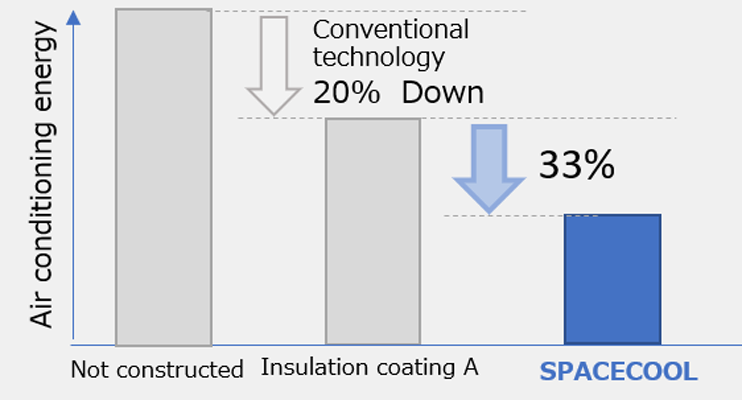
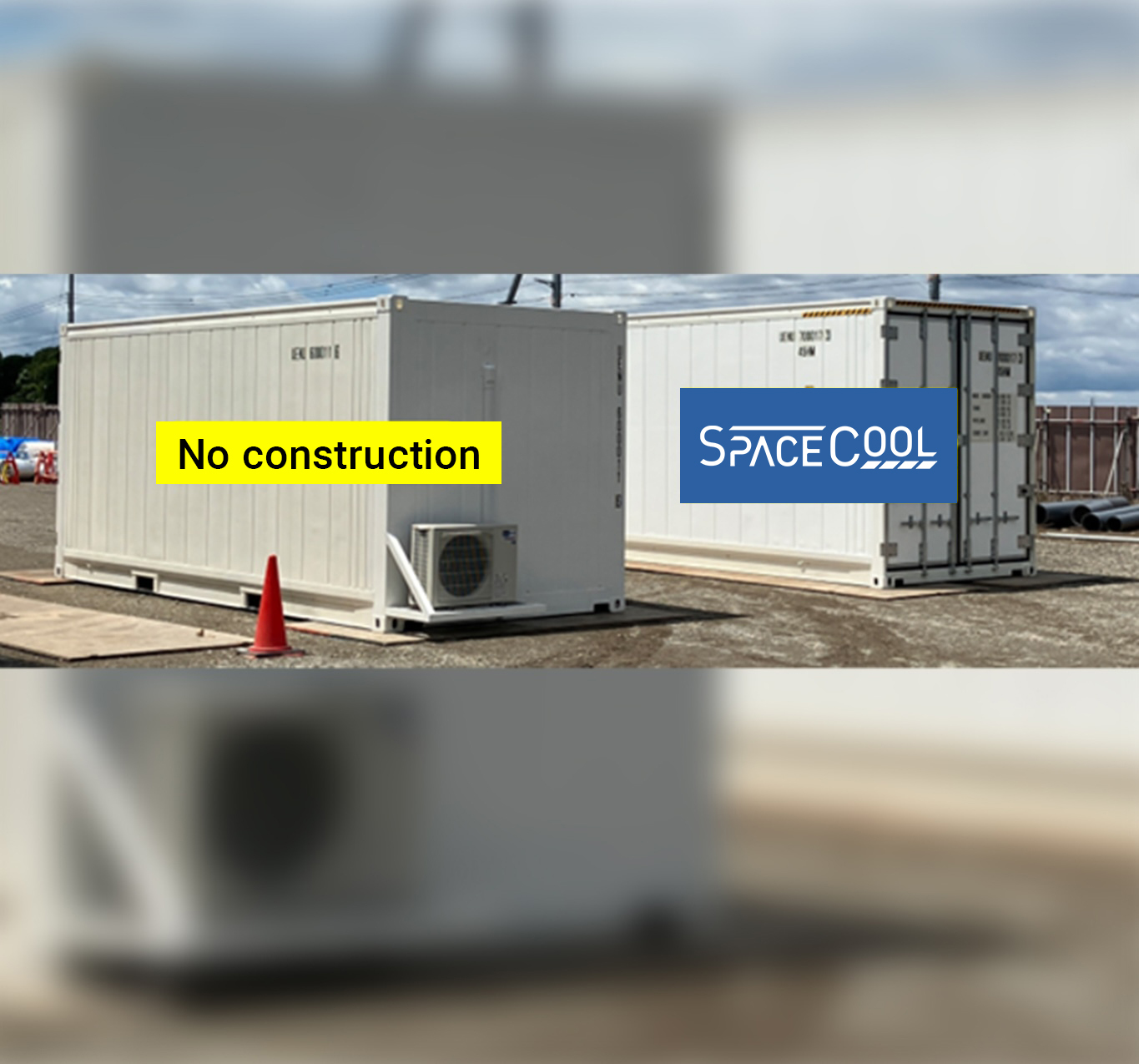
A container house with SPACECOOL applied reduced power consumption by 33% compared to one with heat-shielding paint, and by 46% compared to a standard container house.

Test conditions

Subjects
Three types of container houses: one with SPACECOOL applied, one coated with heat-shielding paint, and one standard unit
Location
Real operating environment at the Honda Yorii Plant

Test results

  • Electricity consumption was reduced by 33% compared with heat-shielding paint and by 46% compared with standard containers.
  • In large-scale automotive plants, simulations indicate a potential CO₂ reduction of up to 2% compared with conventional heat-shielding technologies.
This demonstration project was conducted as a joint development project with Honda Motor Co., Ltd.

Introduction example

Other Solution Examples

Improving comfort and safety, and contributing to climate adaptation and mitigation.
SPACECOOL supports society and people through a wide range of applications.