SPACECOOL Wins Forbes Impact Challenge of the Year 2026 Presented by Forbes JAPAN
ここにこの記事の概要を入力してください。記事の要点や読むメリットを2〜4行程度で入力します。

SPACECOOL INC. has been named a winner of the Forbes Impact Challenge of the Year 2026, a pitch competition presented by Forbes JAPAN at IMPACT STARTUP SUMMIT 2026 on Wednesday, October 7, 2026.
The Forbes Impact Challenge of the Year gives impact startups a platform to showcase their ambitions and business potential as they pursue both solutions to societal challenges and business growth. The event is presented by global business magazine Forbes JAPAN, with the support of the Impact Startup Association (ISA), which shares its mission.
This year, six companies nominated from among ISA’s 250 full members presented the challenges they had taken on over the past year and their potential for the future. SPACECOOL highlighted the impact that its technology is already making in addressing a wide range of heat-related challenges around the world. The company also shared its long-term vision: to take on the challenge of cooling cities and, ultimately, the planet.
Following the pitches, business leaders and experts participating as supporters posed questions designed to bring out each company’s strengths and explore the potential of its business and ambitions. A final audience vote selected three winners, including SPACECOOL.
Building on this recognition, SPACECOOL will further accelerate its efforts to tackle heat-related challenges on a global scale.
About SPACECOOL INC.
Founded in April 2021, SPACECOOL INC. is a Japan-based climate tech startup. The company researches, develops and markets SPACECOOL, a radiative cooling material that leverages the natural phenomenon of radiative cooling to enable zero-energy daytime cooling—something conventional technologies could not achieve. By applying SPACECOOL to buildings, outdoor infrastructure, as well as people, animals, and plants, the technology reduces energy demand and CO₂ emissions, alleviates heat stress, and enhances productivity. With these benefits, SPACECOOL aims to become a game-changer in the fight against global warming.
Official website: https://spacecool.jp/en/
About the SPACECOOL Radiative Cooling Material
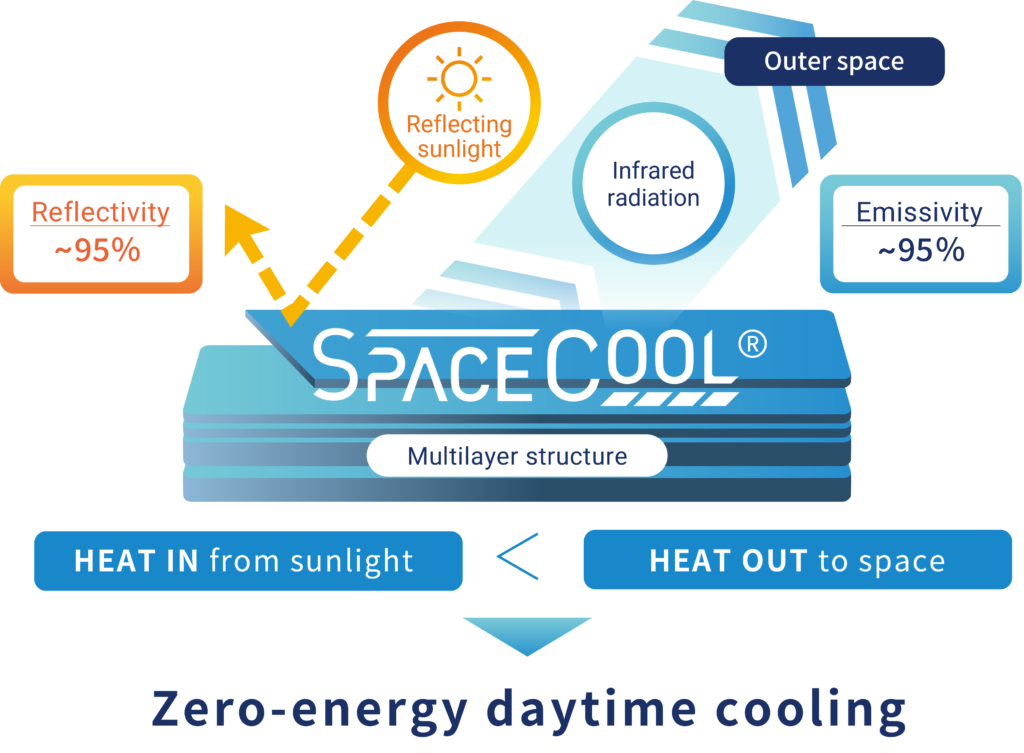
Under direct sunlight, “SPACECOOL” not only blocks solar heat and suppresses heat absorption, but also releases heat to outer space as infrared radiation within the wavelength range of the so-called atmospheric window (*). This enables temperatures to be reduced below the ambient air temperature with zero energy, achieving one of the world’s highest levels of radiative cooling performance.
When applied to buildings, outdoor infrastructure, and even to people, animals, and plants, SPACECOOL contributes to both climate change adaptation and mitigation by reducing air-conditioning energy consumption, enhancing equipment stability, and improving working environments and productivity.