SPACECOOL CEO Masahiro Suemitsu Speaks at UNEP Cool Coalition International Panel — Taking Zero-Energy Cooling Global: Reducing Cooling Demand Itself, Not Just Replacing HFCs — | SPACECOOL INC.
SPACECOOL CEO Masahiro Suemitsu Speaks at UNEP Cool Coalition International Panel — Taking Zero-Energy Cooling Global: Reducing Cooling Demand Itself, Not Just Replacing HFCs —
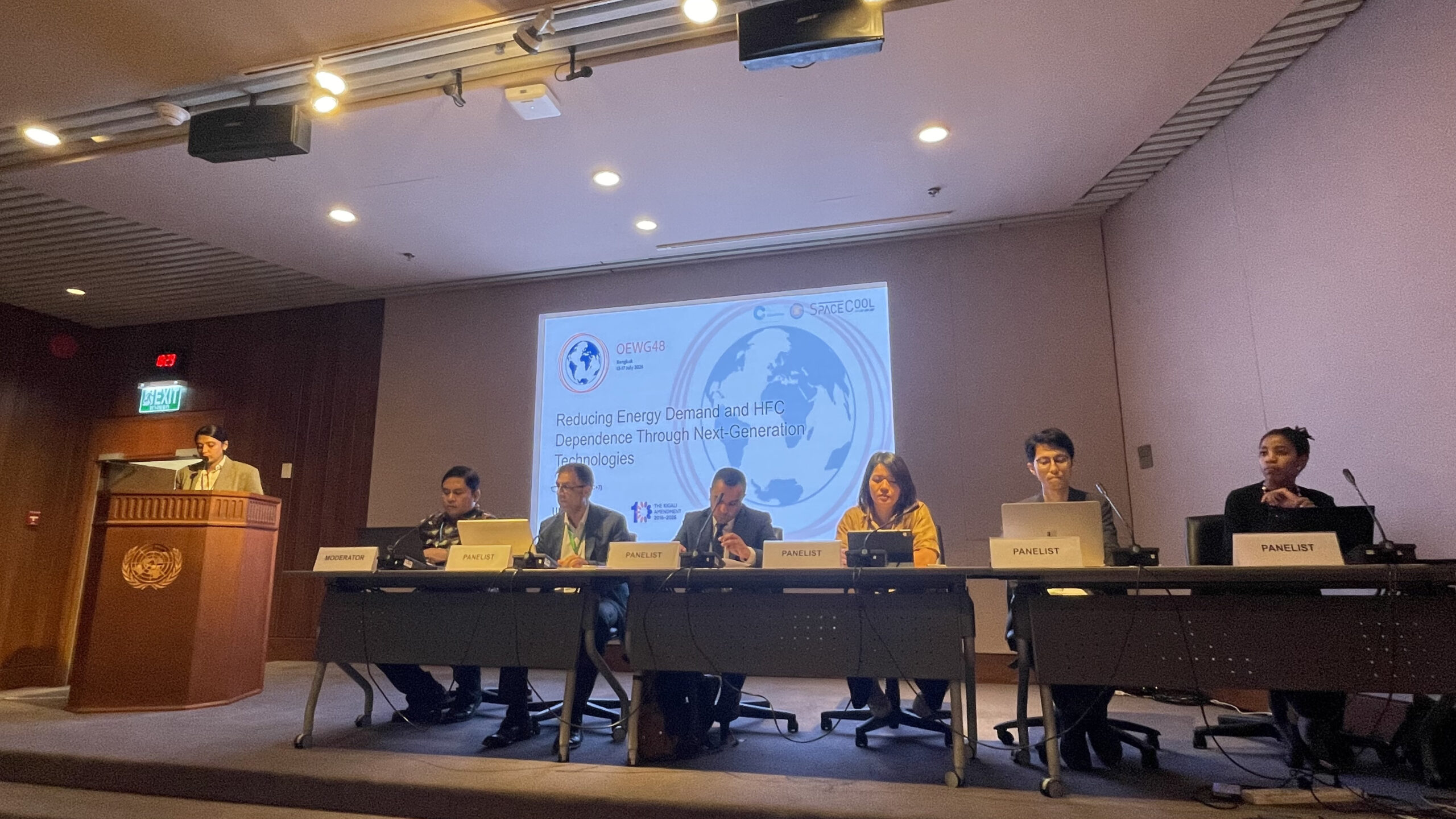
Masahiro Suemitsu, CEO and CTO of SPACECOOL INC., which develops and sells Passive Daytime Radiative Cooling (PDRC) materials that release heat into outer space to provide zero-energy cooling, participated as a panelist in the international panel discussion “Reducing Energy Demand and HFC Dependence Through Next-Generation Technologies,” held on July 14, 2026, at the United Nations Conference Centre in Bangkok, Thailand.
Reducing HFC Dependence Through Passive and Next-Generation Cooling | Cool Coalition
The event was a side event held during the 48th Meeting of the Open-ended Working Group of the Parties to the Montreal Protocol (OEWG48), which took place at the same venue from July 13 to 17, 2026. It was jointly organized by the United Nations Environment Programme (UNEP) Cool Coalition, governments, and leading cooling companies.
The Cool Coalition is an international platform bringing together more than 300 organizations, including governments, businesses, cities, and financial institutions, to advance sustainable cooling and comprehensive action on extreme heat.
From Refrigerant Transition to a Society That Does Not Create Cooling Demand
As global temperatures rise and urbanization accelerates, cooling has become essential social infrastructure for protecting people’s health, daily lives, and economic activity.
At the same time, expanding cooling demand increases not only electricity consumption but also demand for fluorocarbon refrigerants used in air-conditioning systems.
Adopted in 2016, the Kigali Amendment to the Montreal Protocol established an international framework for the phasedown of high-global-warming-potential HFCs. Ten years after its adoption, global cooling policy is placing increasing importance not only on replacing HFCs with lower-impact refrigerants, but also on reducing the thermal loads that create the need for mechanical cooling.
The panel highlighted next-generation technologies that can simultaneously reduce energy consumption and dependence on refrigerants, including radiative cooling surfaces, high-performance insulation, hybrid systems combining fans and air conditioning, and solar-powered off-grid cooling.
Representatives from national governments, international organizations, research institutions, and private-sector companies also discussed the building codes, public procurement, performance evaluation, financing, and market development needed to move these technologies from research and demonstration to widespread implementation.
Bringing Japanese PDRC Technology into Global Cooling Policy
SPACECOOL, the PDRC material developed and sold by the Company, suppresses heat absorption from sunlight while releasing heat from objects into outer space as infrared radiation, cooling them without consuming electricity or other energy.
When applied to building roofs and exterior walls, outdoor equipment, transportation assets, and temporary structures, SPACECOOL reduces heat entering air-conditioning systems and limits temperature rise inside equipment, helping lower cooling energy use, peak electricity demand, and CO₂ emissions.
Suemitsu presented recommendations on the challenges involved in moving PDRC technology from research and innovation to widespread implementation, addressing not only technical performance but also:
・internationally comparable performance evaluation methods and standardization;
・integration into building codes and public procurement systems;
・mechanisms that appropriately evaluate upfront investment against long-term energy savings; and
・demonstrations in countries worldwide, including hot-climate regions, and the development of local partnerships.
He offered recommendations from these perspectives.
According to the event’s official description, technologies including radiative cooling surfaces are moving from the laboratory to the market, while countries such as Japan and Italy are highlighted as innovation hubs for next-generation cooling technologies.
The Company aims to scale radiative cooling technology developed in Japan not merely as an energy-saving material, but as social infrastructure that can fundamentally reduce global cooling demand and dependence on refrigerants.
Comment from Masahiro Suemitsu, CEO and CTO
Global cooling policy is moving beyond a focus solely on more efficient air-conditioning systems and lower-impact refrigerants toward a focus on how to reduce the thermal loads that create the need for cooling in the first place.
In addition to “Reduce”—cutting emissions and energy consumption—the concept of “Avoid”—preventing energy use and refrigerant demand from arising in the first place—will become increasingly important.
Radiative cooling technology is not a competitor to air-conditioning systems. By reducing the heat entering buildings and equipment at the outset, it enables air-conditioning systems to be smaller and more efficient, while reducing the amount of energy and refrigerant they use.
I am deeply honored to discuss with governments and international organizations involved in the Montreal Protocol the policies, standardization, and market development needed to bring radiative cooling technology into widespread use. I hope this will be a step toward delivering a technology developed in Japan to people around the world who are facing extreme heat.
Next Steps
Going forward, the Company will strengthen collaboration with national governments, international organizations, research and evaluation institutions, and companies in the building and infrastructure sectors. It will work to establish performance evaluation methods for radiative cooling technology, advance international standardization, conduct demonstrations in countries around the world, and incorporate the technology into building and procurement systems.
By adding cooling functionality to the surfaces of buildings and outdoor infrastructure, the Company also aims to promote a new form of cooling infrastructure that reduces excessive reliance on conventional air conditioning and mitigates heat-related challenges without consuming energy.