SPACECOOL Demonstrates Heat Mitigation Effect of Radiative Cooling Tents — Improving Outdoor Sports Environments in Summer and Reducing Heatstroke Risk to Enable Comfortable Outdoor Spaces —
SPACECOOL INC. implemented a joint project in collaboration with the Tokyo Metropolitan Government and the World Athletics Foundation at the World Athletics Championships Tokyo 2025 (hereinafter referred to as “WCH Tokyo 25”) to evaluate the effectiveness of heat countermeasures in outdoor environments using tents incorporating its radiative cooling material, SPACECOOL.
The results demonstrated that SPACECOOL tents contribute to improving outdoor sports environments and reducing heatstroke risk, thereby enabling the realization of safe and sustainable outdoor sports environments during summer.
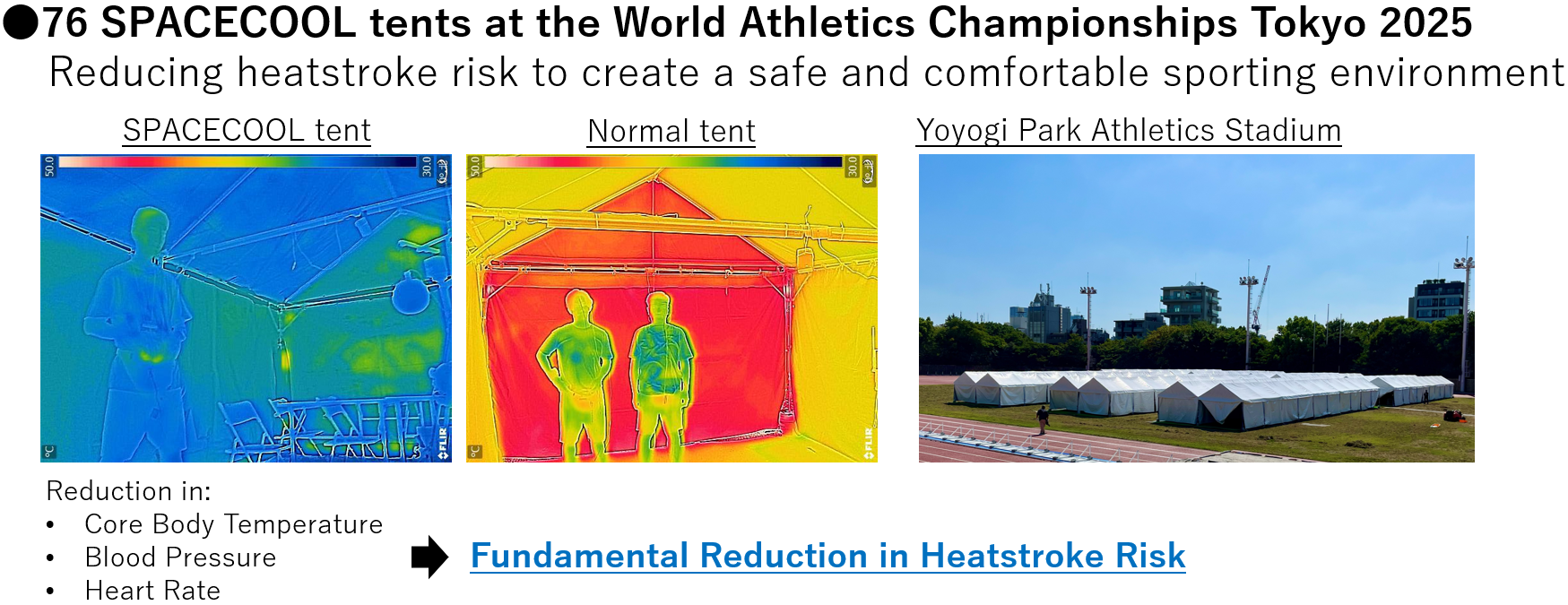
In this joint project, a research group led by Professor Shinji Yoshida of the Department of Human Life Environment, Faculty of Human Life and Environment, Nara Women’s University, conducted a comprehensive third-party evaluation. This evaluation covered not only environmental indicators (air temperature, mean radiant temperature, WBGT, etc.) but also human thermophysiological responses and qualitative user assessments.Figure 1: Overview of the joint project — Compared to normal tents, SPACECOOL tents were confirmed to improve participant comfort.
Background of the Joint Project
In recent years, the risks associated with heat exposure during outdoor sports and events in summer have intensified due to climate change and the urban heat island effect.
At the WCH Tokyo 25, heat countermeasures are positioned as a key priority under the guiding principle of delivering a “sustainable and safe event,” with the aim of ensuring safe and sustainable operations for all participants, including staff, volunteers, and spectators.
Against this background, in May 2025, the Tokyo Metropolitan Government and the World Athletics Foundation held a pitch contest titled “Public-Private Partnership PITCH (WCH Tokyo 25 Collaboration Course)” to select new heat countermeasure technologies for the event. SPACECOOL’s proposal—utilizing SPACECOOL tents to improve outdoor thermal environments in a simple and sustainable manner without the use of electricity—was awarded first place, leading to the implementation of this joint project.
[Objective]
As part of heat countermeasures for the WCH Tokyo 25, this project aims to scientifically verify, under real-world conditions, the extent to which SPACECOOL tents contribute to improving the outdoor thermal environment and enhancing user comfort.
[Measurement Items and Evaluation Methods]
Under the leadership of a research group led by Professor Shinji Yoshida of the Department of Human Life Environment, Faculty of Human Life and Environment, Nara Women’s University, a comprehensive evaluation was conducted from the following three perspectives:
・Environmental Evaluation:
Air temperature, humidity, solar radiation, globe temperature*¹, mean radiant temperature (MRT)*², and Wet Bulb Globe Temperature (WBGT)*³ were measured. A comparative evaluation was conducted under identical conditions across three environments: SPACECOOL tents, conventional tents (hereinafter referred to as “normal tents”), and the outdoor environment outside the tents.
・Human Thermophysiological Response Evaluation:
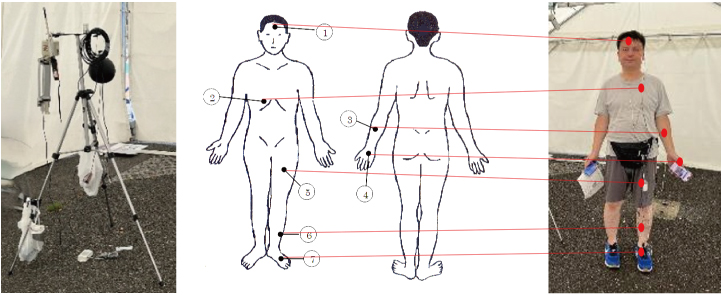
Participants were equipped with compact sensors to continuously measure mean skin temperature, lower limb temperature, ear temperature (core body temperature), and other indicators, in order to assess differences in thermal load on the human body depending on the environment.
・Qualitative Evaluation:
Interviews were conducted with users to collect subjective assessments regarding comfort, differences compared to normal tents, and likelihood of repeated use.
*¹ Globe Temperature (Black Globe Temperature): Measured using a globe thermometer (black globe), this indicator reflects the combined effects of radiant heat, air temperature, and airflow, and serves as a key metric representing the impact of radiation in hot environments.
*² Mean Radiant Temperature (MRT): An indicator that expresses, as a temperature, the effect of radiation from surrounding surfaces on the human body, and is used to evaluate the influence of the radiant environment on perceived temperature.
*³ Wet Bulb Globe Temperature (WBGT): A heat stress index that comprehensively accounts for the effects of air temperature, humidity, radiation, and wind. Higher values indicate greater physiological strain on the human body and a higher risk of heatstroke.
Figure 2: Globe temperature measurement device (left) and locations of temperature sensors used to measure participants’ thermophysiological responses
[Demonstration Conditions]
In this joint project, a total of 76 SPACECOOL tents were installed across multiple venues of the WCH Tokyo 25, including the outer areas of the Japan National Stadium, Meiji Park, and Yoyogi Park. Among these, the effectiveness evaluation was conducted at Yoyogi Park Athletics Field (ODA Field).
Location: Yoyogi Park Athletics Field (ODA Field)
Target environments: SPACECOOL tents / normal tents / outdoor environment outside the tents
Demonstration period: September 8, 9, and 16–19, 2025
[Project Structure]
Lead: Research group led by Professor Shinji Yoshida, Department of Human Life Environment, Faculty of Human Life and Environment, Nara Women’s University
Collaborators: Tokyo Metropolitan Government, World Athletics Foundation, SPACECOOL INC.
Figure 3: Professor Shinji Yoshida, Department of Human Life Environment, Faculty of Human Life and Environment, Nara Women’s University
Key Demonstration Results
The results demonstrate that SPACECOOL tents reduce thermal load and improve comfort compared to normal tents, based on both measured data and qualitative assessments.
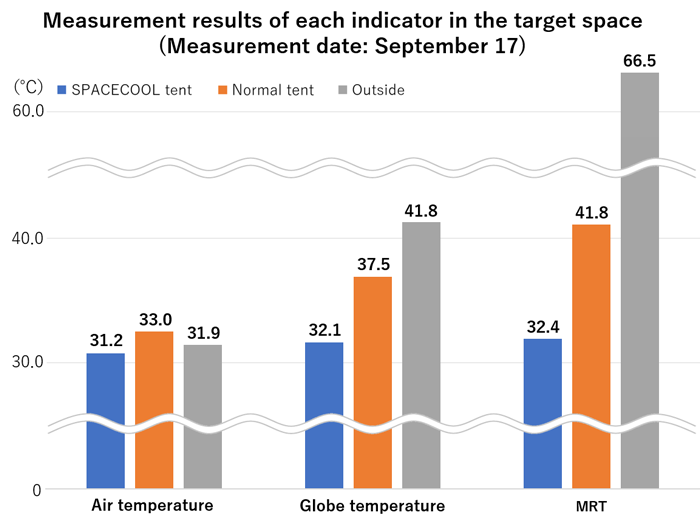
・SPACECOOL tents achieved maximum reductions, compared to normal tents, of 1.8°C in air temperature, 5.4°C in globe temperature, and 9.4°C in mean radiant temperature (MRT) (Figure 4).
・SPACECOOL tents improved WBGT by approximately 1.6 points compared to normal tents.
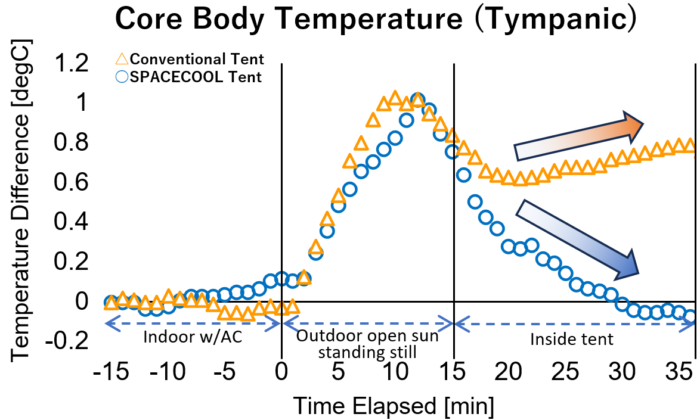
・Participants who stayed inside SPACECOOL tents exhibited lower mean skin temperature and lower lower-limb temperature, both of which are indicators associated with heat stress and heatstroke risk. In addition, their core body temperature (tympanic temperature) showed a decreasing trend (Figure 5).
・In qualitative evaluations, many users reported experiencing a cooling effect due to radiative cooling and gave high ratings for comfort, cost-effectiveness, and potential for future use.
Figure 4: Measurement results of each indicator in SPACECOOL tents, normal tents, and the outdoor environment outside the tents
Figure 5: Changes in Core Body Temperature (Tympanic Temperature) A decreasing trend in core body temperature was observed only in the SPACECOOL tent condition.
Future Outlook
Through this joint project, we believe that the social effectiveness of radiative cooling technology in outdoor sports environments during summer has been successfully demonstrated.
Furthermore, rather than treating these outcomes as a one-time initiative for the World Athletics Championships Tokyo 2025, we aim to leverage them as a lasting social legacy. By expanding deployment through collaboration with local governments—not only in sports environments but also across various outdoor settings such as event operations, public spaces, disaster preparedness, and education—we will promote the broader adoption of this approach as a sustainable social model.